

THE PLANNING INTENSIVE
Every January your team nods at the plan. By March, nobody can tell you what it was.
One day with your leadership team, and a plan that's still running in March.
You bring your leaders and I'll run the room. By the end of the day you've made the hard calls together, and I stay close for the next 30 days while the plan finds its feet.
I have two of these left in 2026, and two more in January.
How planning usually goes
You tell yourself you'll take a day in December to think about next year. Then a client calls on the Tuesday you blocked, and that day's gone.
So the plan gets written on a Sunday night at the kitchen table. By you. You clean up the slides and walk the team through it at the January kickoff, and everybody nods. Your head of delivery and your sales lead walk out with two different versions of it in their heads, and your ops person is mostly wondering who's supposed to do all of this.
By March nobody has opened the file. You're making every call again, and if you're honest, you're a little tired of being the only one who remembers what the plan said.
I've sat in a lot of those January meetings. Most of the time the strategy itself was fine. The team just never got to argue about it, so they never owned it.

What the day looks like

It's one full day on Zoom, with you and your leadership team.
We open with your Winning Aspiration. That's a fancy name for a plain question: what are you actually building, and who is it for? Everything we decide after that has to point back to it.
Then we work through five choices in order. I won't let the room move on until everyone can live with the answer in front of them. Some take twenty minutes. One usually takes two hours, and that's almost always the one that mattered most.
Where you'll compete. Which clients and markets get your people's time, and which ones you quietly stop chasing.
How you'll win. The reason a client picks you over the firm down the street.
What you have to be great at. Usually three to five things. If your list has eleven, we're not done yet.
How you'll run it. Who decides what, and what changes on an ordinary Tuesday so the first three answers actually happen.
How you'll keep score. A short list of numbers your team can check every week without a spreadsheet tutorial.
Fair warning: some things you enjoy doing won't survive the day. I know that stings. I'd still rather you cut them in December, with your team in the room, than in July when everyone's too stretched to say no.
What you walk out with

Your strategy documented, with full buy-in and understanding from your leadership team.
Next year's priorities, with first-quarter milestones and a name next to each one.
A weekly scoreboard.
The leadership meeting rhythm, down to who's on the hook for what between meetings.
A written “NO” list. You'll want it in April, when a shiny opportunity shows up and somebody on the team gets excited.
Nothing arrives in your inbox a month later as a 40-page report. You can start the next morning.
The 30 days after
January is where most plans go to die, so I don't disappear after the session.
For 30 days we check in regularly, and when something comes up you call me instead of guessing. Real life is going to push back on the plan. That's normal, and we'll adjust it together.
With your team, not to your team
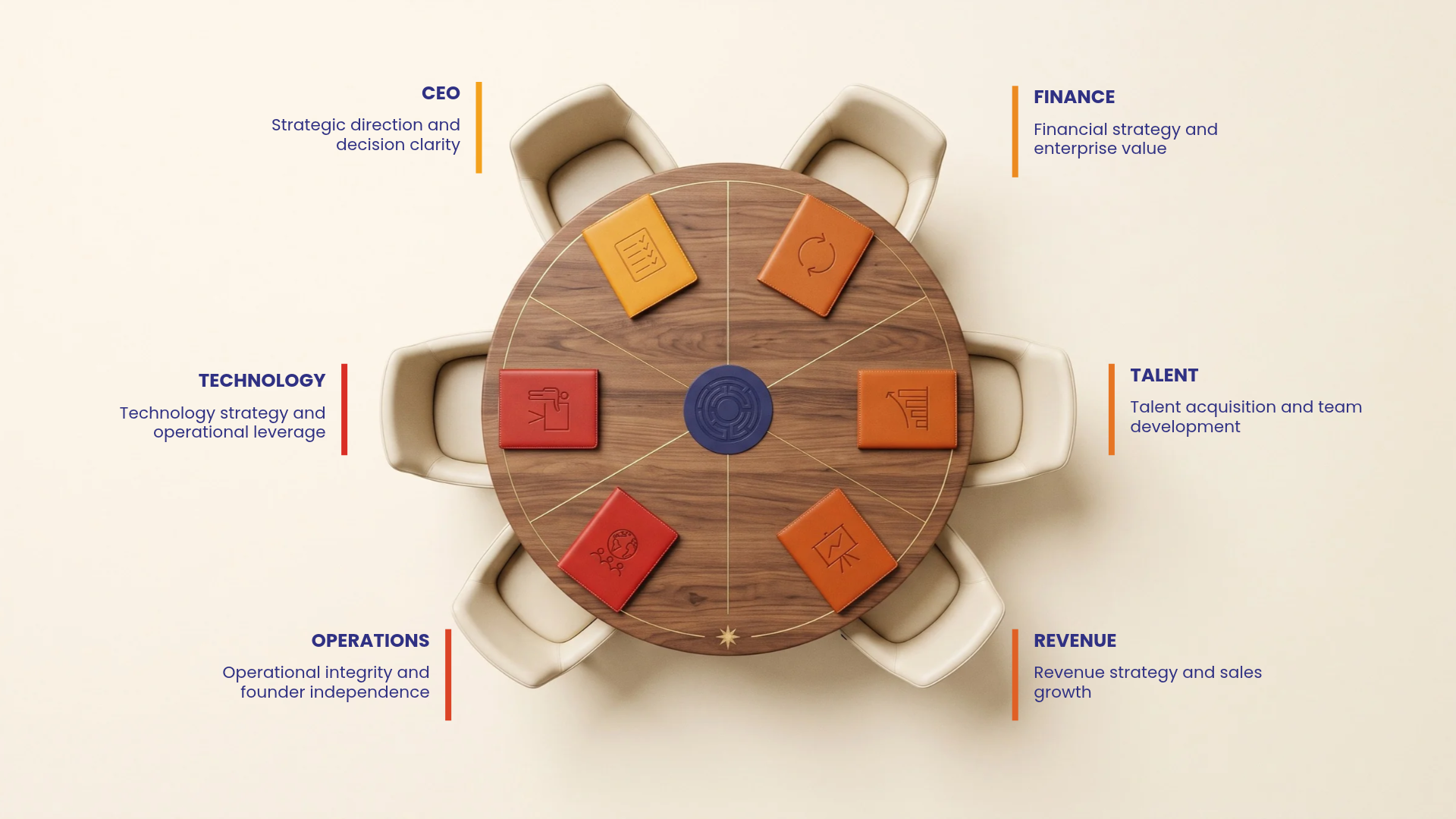
Most planning gets done TO a team. The founder writes the plan, hands it down at the kickoff, and the team does what people do with a plan they didn't make. They nod, and then they go back to their week.
This day is built WITH your team. Your leaders are in the room when the hard calls get made, and a few of those calls will start as arguments. When your head of sales is the one who pushed to drop a client segment, nobody has to sell them on it in January. They'll defend it for you.
It's also why the plan actually gets carried out. People follow through on decisions they helped make, and they speak up early when one starts slipping, because it's their plan too. Your team can't own what isn't clear, and after a day of arguing it out together, it's clear.
And for once you're not the only person in the building who can explain where the firm is headed.
Who this is for

You run a professional services firm doing somewhere between $5M and $25M a year.
You've got good leaders, but most decisions still end up on your desk.
You've written a plan before and watched it fade by spring.
You'd rather make a few hard choices than keep chasing every good idea that walks in the door.
It's probably not a fit if you're hoping someone will write the plan for you. I won't, because a plan I write is a plan your team doesn't own. You and your leaders make the calls. I run the room and keep everyone honest, me included.

“Jen has guided us through a year transitioning to a self-managing organization. She helped us draw the map of where we want to go.”
Patty Lawrence, Founder, Turbo Execs

“Jen’s a super sharp strategist who understands what it takes to get operational alignment, help the Visionary leader become free from the weeds of operational overcommitment, and get the team focused on the goals that will serve an organization best.”
Krista Clive-Smith, CEO, KCS Family of Companies
Investment
$10,000
That covers the full day, my read of your pre-work beforehand, everything you walk out with, and the 30 days after.
If the day shows you need more than a plan, $5,000 of what you paid goes toward our Stabilize or Strategize programs, as long as you sign within 30 days of your Intensive. There's no obligation. Plenty of founders take the plan and run with it on their own, and I'm happy when that happens.
I have two of these left in 2026, and two more in January.
What clients say
Our commitment to continuous improvement includes post planning session surveys. The following is a representative sample of that feedback from clients and participants.


Questions founders ask
How do we get ready?
There's a short pre-work form for you and each of your leaders. It asks where you're stretched thin and which clients cost more than they're worth. The hard one is which opportunities you're chasing mostly because you're scared to let them go. Answer it honestly and the day goes faster.
How is this different from a planning retreat?
Retreats are fun. There's a nice dinner and a photo of the whiteboard, and then Monday happens. This day ends with decisions that have owners and a meeting rhythm to keep them alive, and I'm around for 30 days to make sure they stick.
Who should be in the room?
Whoever is going to run the plan. For most firms that's your Ops Leader and the people who run delivery, sales and finance.
We already have a plan. Is this still useful?
Bring it. We'll put it through the five choices and see what holds up. Most plans I see have plenty of goals in them and very few real choices.
What happens after the 30 days?
Some teams take it from there on their own. Others want someone holding the year with them, with quarterly planning and senior advisors at the table. That's Strategize. And if the day makes it clear the business still runs through you, that's Stabilize. Either way, part of your Intensive goes toward it.
What if strategy isn't the real problem?
Then I'll tell you. Sometimes the plan is fine and the business just can't carry it without you holding everything up. I'd much rather you find that out in December than in June.
Start with a conversatioN
Book an hour with me. We'll talk about where the business is today and where you want it to be next December. By the end you'll know whether a Planning Intensive is the right first move, and if it isn't, I'll tell you what I'd do instead.
I have two of these left in 2026, and two more in January.